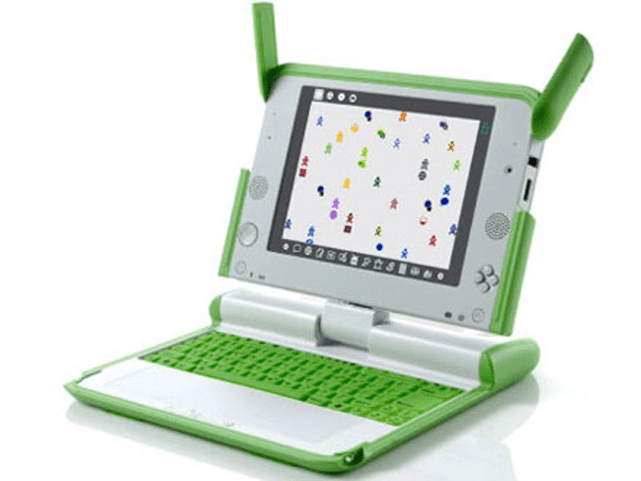
This article focused on the plan to build $100 laptops for school-age children as part of the One Laptop per Child (OLPC) conceived by MIT professor Nicholas Negroponte. This model would have provided children in schools across the nation so that students were able to learn and research more information for their studies. This idea is quite interesting in that it would allow children in economically challenged schools to have the same opportunities as other kids (Young, 2015).
The unfortunate part of this story is that the plan designed XO computers which cost about $130 to create and were not as easy to use as the design had promised. The computers required students or children to teach themselves how to use the computer. The idea of the “give one, get one” campaign was widely publicized but the follow through was not as well received as the creators hoped. In fact, instead of hundreds of millions of computers ordered, there were only about 3 million computers built. The orders just did not come in as expected. This was unfortunate and the computers wound up being used mainly in Latin America. According to the Engineering for Change website (www.engineeringforchange.org), the laptops met the regulations and safety requirements for the computers and were used mostly in Uruguay and Peru as well as countries in the middle east. Children in these countries were honored to receive the laptops (Young, 2015). Although the project was criticized, it did offer children the chance to learn things even if their families could not afford the computers. Also, the computers are available to families so that all members of the family had the opportunity to learn with the laptops.
The OLPC model was unfortunately destined for failure. The idea did not really catch on with the general public and schools did not order and purchase the computers. Not only did the computer actually cost upwards of $130 and more, the give one, get one campaign in which someone could buy a computer and given one to a needy student, cost approximately $399—more than the $100 cost advertised (Silverman, n.d.). One complaint about the project was that children in underdeveloped countries might need other resources such as food and water more than a computer. The laptops were made to withstand all kinds of environments. As of 2010, there were many components that were needed to make the computer (Govtech, 2010). It might be that the components and necessary functions made the computers difficult to make.
All in all, the idea for the XO computers was a good one in that it was planned to help children be able to learn in all types of environments. The fact that the idea did not produce better results is unfortunate. I think that it could have really made a difference in the lives of children across the globe.
References
Engineering for change. XO laptop. (2024). Retrieved from https://www.engineeringforchange.org/solutions/product/xo-laptop/#snapshot
Govtech. (2010). One laptop per child announces final beta version of its XO laptop. Retrieved from https://www.govtech.com/education/one-laptop-per-child-announces-final.html
Silverman, J. (n.d.). Will the $100 laptop help save the developing world? Retrieved from https://computer.howstuffworks.com/hundred-dollar-laptop.htm
Young, J. R. (2019). What happened to the ‘$100 laptop’? EdSurge Podcast.
 Janet Bolois Blog Page
Leave a comment